

Project Details
- Architect: Jadric Architektur ZT GMBH
- Type: Invited Competition
- Program: Townhouse with public ground floor zone
- Year: 2024
- Location: St. Pölten, Austria
- Project Team: Mladen Jadric, Nikolaus Punzengruber, Gabriela Del Rosal, Selina Pick, Charlotte Hemmen, Lamia Hadzic
- Visualisierungen: Claudio Anderwald
Project Description
CONNECTION AND URBAN STRUCTURE
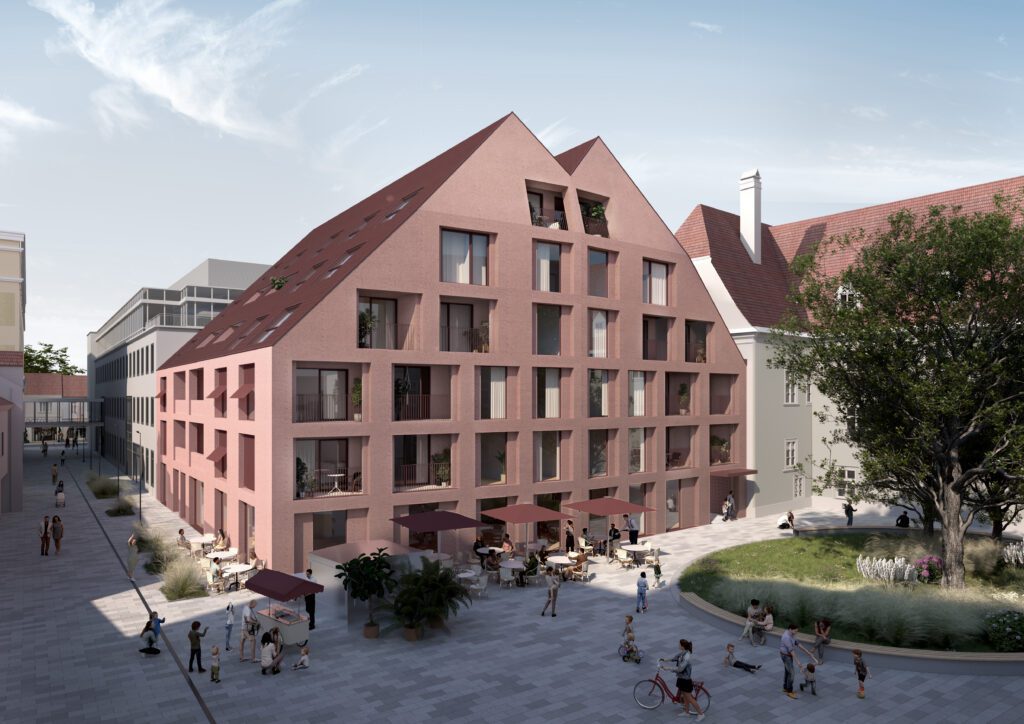
The 15-minute city thrives on the degree of density and the intensity of landmarks, buildings, and pathways within a space. The new project at Sparkassenplatz serves as an exemplary model for the necessary densification of urban areas with maximum proximity, richness, and compactness. This concept also aims at a tactile perception of the city. Residents find self-expression through a dialogical and tactile experience of the spaces. Planned elements include: paths, corridors, porosity and transparency of the ground floor spaces, as well as the tactile quality of materials. The color concept and the use of sgraffito patterns (scratch plaster) represent a new interpretation of the traditional architectural elements of the surrounding context.
SPATIAL FORM AND SCALE OF INTERVENTION
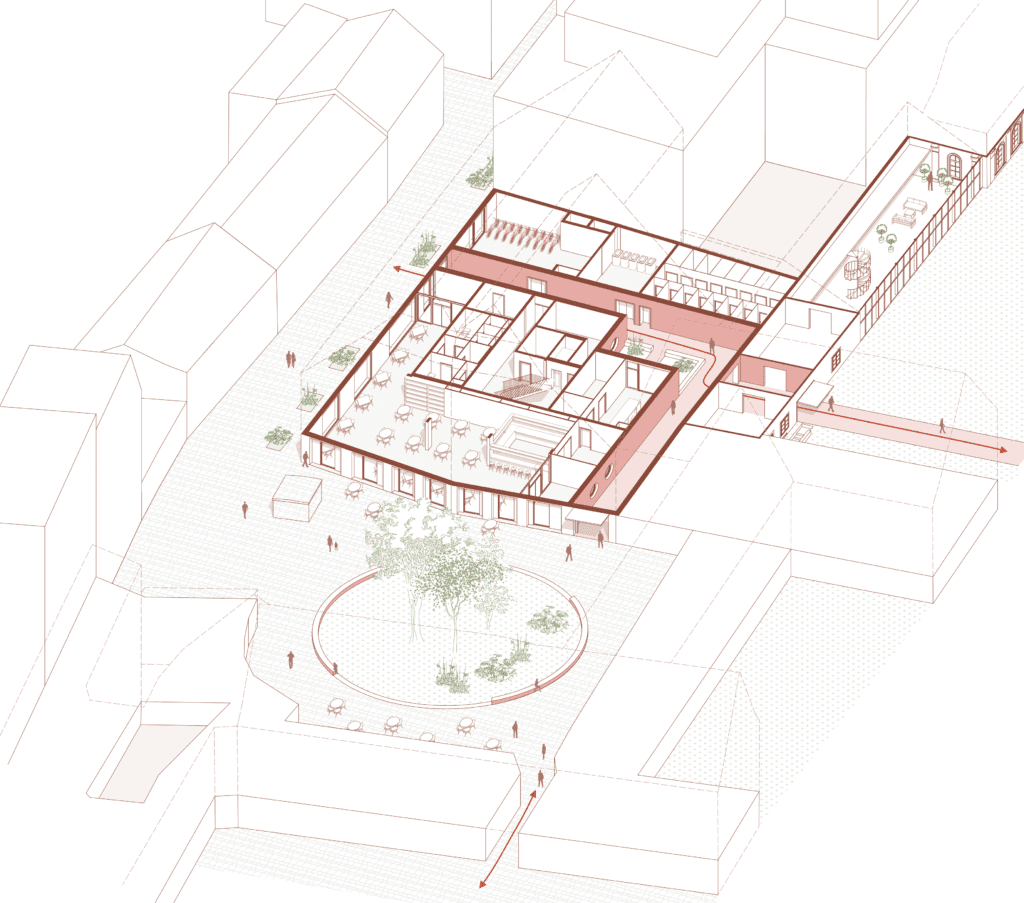
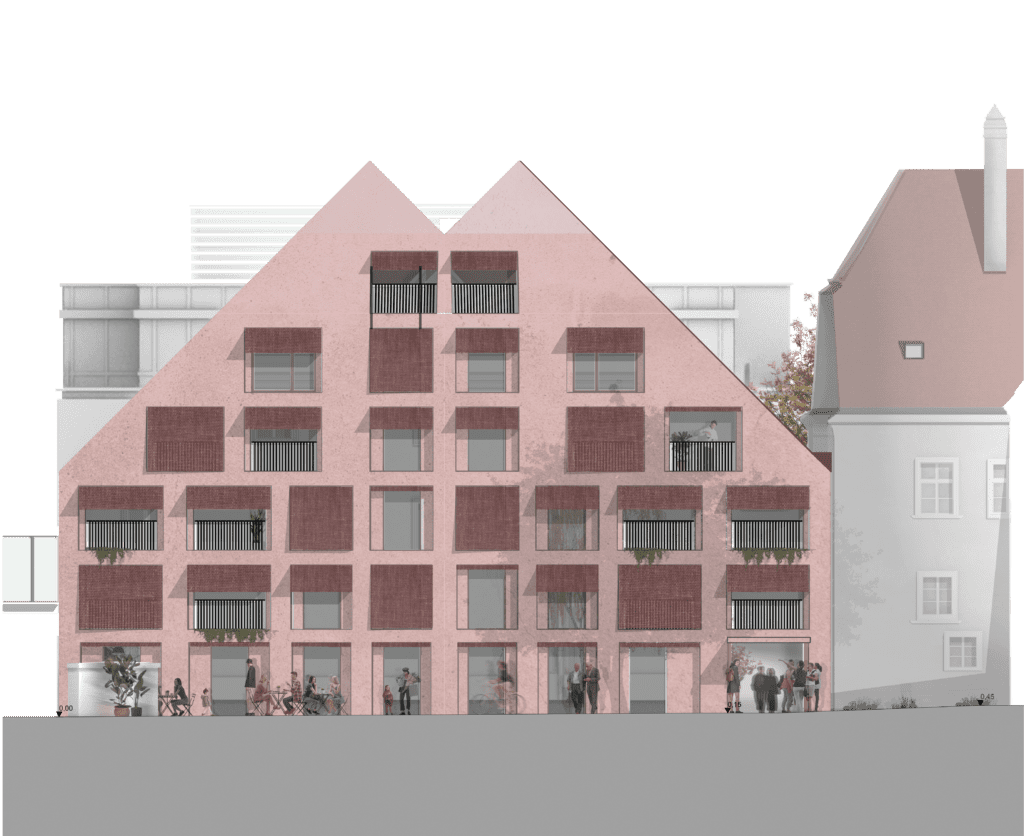
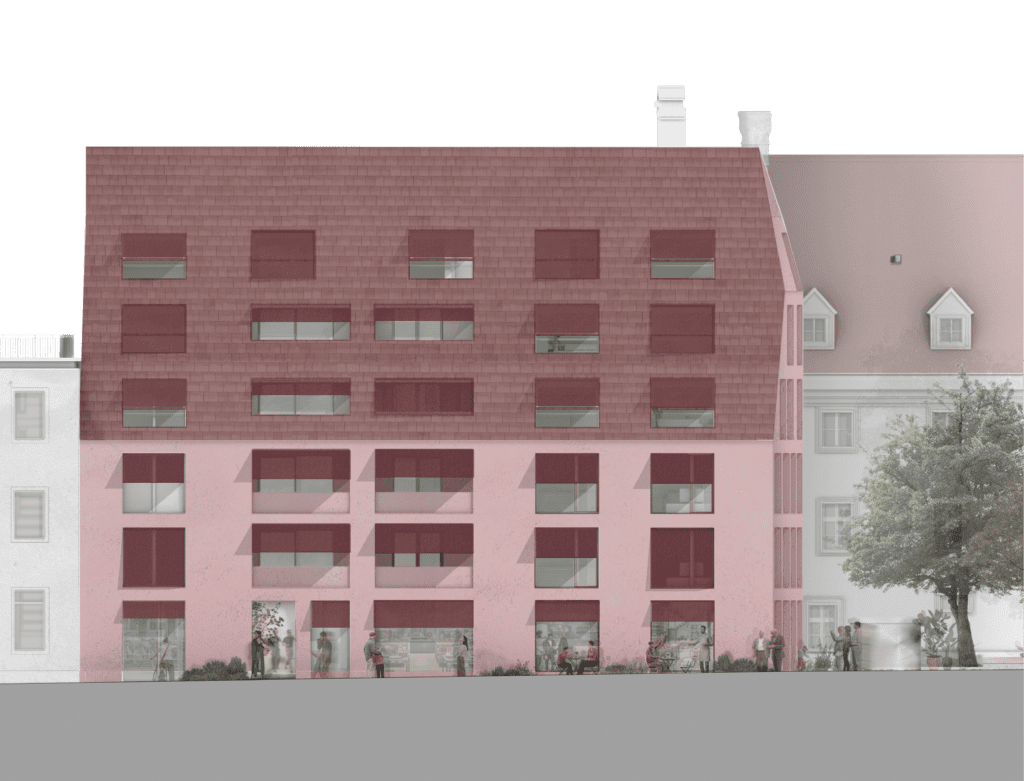
After the demolition of the existing building, a precisely formulated volume is introduced to carry out an “urban repair.” The building volume responds with its scale to the newly designed Sparkassenplatz to the south, and to the height and lighting conditions of Grenzgasse to the west. To the north, the form and greenery of the façade ensure a seamless continuation of the building fronts, while to the east, the volume opens toward the garden pavilion of the Bishop’s Garden. The design of the openings facing Sparkassenplatz continues the principle of the “punched window façade” of the diocesan building. The combination of deep loggias and French windows appears both dignified and playful. The plaster façade of the sculptural volume reflects the harmonious appearance of the surrounding townhouses and their architectural integrity. The identity-defining sgraffito accompanies the brightly lit public walkways through the building.
“GREEN SPACES” AS SOCIAL SPACES – INDOOR AND OUTDOOR
The project offers a diverse range of spatial experiences for residents while simultaneously serving as a platform for exchange in a socially connected city.
URBAN ECOSYSTEM AND HABITAT
After analyzing which spatial concepts are essential to improve the quality of urban living, a “Green Neighborhood” concept was developed, divided into three locations: the New Orangery, the co-working/shared office “Bel-Vedere,” and the “Green Salon” in the center of the square. The new Orangery is a multifunctional space for urban gardening, meditation, and reading. The entire neighborhood benefits equally from this area. The Green Salon aims to replace the existing urban heat island in the square—urban biodiversity can be achieved here even on a small scale.
DESIGN OF THE RESIDENTIAL BUILDING
The slightly bent building frontage visually guides toward two key directions: the city passage and the traffic-calmed Grenzgasse. The sloped roof form helps structure and scale the building in relation to the square and provides a gentle and logical connection to the existing building of the diocese.